
Anatomy education in physical therapy programs is under structural pressure. Dissection lab access is declining across curricula. Textbooks and atlases treat anatomy separately from function and clinical application. Students end up with anatomy knowledge that lives apart from the clinical reasoning they need from day one of practice.
Why Is Anatomy So Hard to Teach in Physical Therapy Programs?
Three structural pressures make anatomy education uniquely difficult in physical therapy and physiotherapy (PT) programs: shrinking dissection time, the need to connect anatomy to clinical decisions, and compressed teaching hours within a curriculum where scope of practice keeps expanding.
Dissection time is shrinking. Dissection lab access has declined steadily across PT programs, which increasingly need alternative resources that can shoulder anatomy instruction without compromising outcomes.
Anatomy needs to connect to function and clinical decisions. PT students need to reason about movement, joint mechanics, and manual assessment from day one of practice. Anatomical identification is the starting point for that reasoning, and most existing resources stop there.
Teaching hours are compressing as scope of practice expands. Physical therapy scope continues to grow. Ultrasound-guided assessment, direct-access primary care, and advanced manual therapy are all expanding areas. The anatomy hours available to cover the underlying foundation are getting squeezed.
The result is a gap between the anatomy PT students are taught and the anatomy they need to apply in the clinic. That gap is what PT educators are trying to close.

Why Do Traditional Anatomy Resources Fall Short for Physical Therapy?
Most existing anatomy resources were not designed with the PT clinical use case in mind.
Textbooks and atlases treat anatomy as reference material. Students identify structures and memorize origins, insertions, and innervation. Functional context and clinical correlation sit in separate chapters or separate books.
Generic 3D anatomy platforms function as content libraries. Students browse, but the structure of the learning is left to the student or the instructor to build. There is no guided pedagogy, no clinical framing, and no assessment alignment specific to physical therapy.
Neither format is aligned to a published consensus syllabus for PT. The Anatomical Society has published core anatomy syllabi for medicine, nursing, pharmacy, and dentistry. No similar formal syllabus exists for physiotherapy. Gangata et al. in Clinical Anatomy (2023) filled that gap with 182 consensus-driven learning outcomes for entry-level UK physiotherapists, but few teaching resources have been built around it.
The result is that PT programs patch together anatomy instruction from resources designed for other disciplines, or ask students to self-organize their learning across multiple tools. Both approaches are inefficient and can create barriers to learning.
What Is Anatomy Tutorials for Physical Therapy?
Anatomy Tutorials for Physical Therapy is a video-led learning module on Anatomy.tv, Primal Pictures’ interactive 3D anatomy platform. It was developed in partnership with Physiopedia, “the Wikipedia for the rehab profession.”
The module provides 25 expert-authored video tutorials, each approximately 20 minutes long, covering functional anatomy, neuroanatomy, goniometry, and core systemic anatomy required across physical therapy, physiotherapy, and allied health education. Every tutorial teaches anatomy in the context of function and clinical application. The content was developed with reference to the Gangata et al. (2023) consensus learning outcomes for entry-level physiotherapists.
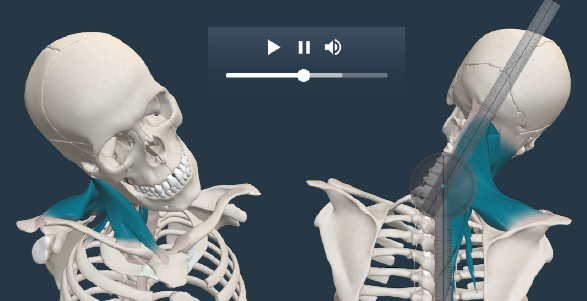
The videos integrate interactive 3D models, animations, and dissection and ultrasound imagery drawn from the broader Anatomy.tv portfolio. Multiple-choice questions follow each video for self-assessment and knowledge retention. All content is embeddable into an LMS or VLE for use in flipped classrooms, pre-class or post-class assignments, lab sessions, and exam preparation.
How Is Anatomy Tutorials for Physical Therapy Different from Other 3D Anatomy Platforms?
Anatomy Tutorials for Physical Therapy differs from generic 3D anatomy platforms in three specific ways.
It is video-led and guided. Expert-authored video tutorials walk students through each topic with clear learning objectives, 3D visuals, and clinical context throughout. Students follow a structured sequence through each topic instead of building one themselves from a library of models.
It is purpose-built for physical therapy. The 25 tutorials cover the functional anatomy, neuroanatomy, goniometry, and systemic anatomy that entry-level physio/physical therapists actually need. Every video was developed with reference to the Gangata et al. (2023) consensus syllabus.
It integrates functional and clinical context by default. Every tutorial includes ultrasound imagery, dissection stills, movement animations, and disease and conditions content alongside the 3D structures being taught. Clinical context sits in the same view as anatomical detail.
No other 3D anatomy platform currently offers physical therapy content in a tailored, guided, video-led format built referencing a published PT consensus syllabus.

How Does Anatomy Tutorials for Physical Therapy Work?
The module works through five core features, each mapped to a specific use case for PT students or educators:
25 expert-led video tutorials, each approximately 20 minutes. Anatomy teaching hours in PT programs continue to compress. Expert-authored sessions give students structured coverage of the topics Gangata et al. (2023) identified as core, designed to fit lectures, labs, and placements.
Multiple-choice questions for self-assessment, with trackable scores. Retention is a persistent problem in PT programs, particularly before clinical exams and placements. Trackable self-assessment lets students identify weak spots before high-stakes moments, and gives faculty visibility into cohort readiness.
Interactive 3D models, animations, and goniometry from Primal’s 3D Real-time Functional Anatomy module. Physical therapy demands spatial reasoning about movement, joint mechanics, and manual assessment that 2D textbook anatomy cannot deliver. 3D visualization builds the applied understanding students need in clinical practice.
Curated clinical content from the Anatomy & Physiology, Disease & Conditions, and Upper and Lower Limb Ultrasound modules on Anatomy.tv. Students struggle to connect textbook anatomy to real clinical decisions. Integrated clinical content bridges anatomy to practice, and the ultrasound modules address a growing area of PT scope that most core curricula are still catching up with.
Direct LMS and VLE integration through link sharing or embedding. Digital anatomy resources that live outside the LMS tend to go unused. Direct integration into Canvas, Blackboard, Moodle, or Brightspace, etc. puts content where students already work, without extra setup for the educator.
The module is designed to layer onto existing PT anatomy curricula. Faculty use it alongside dissection, lectures, and lab work.
What Does the Research Say About 3D Anatomy Resources in Physical Therapy Education?
Four peer-reviewed studies frame the case for digital, video-led anatomy resources in PT education.
Reduced dissection time does not have to compromise outcomes. Donovan et al. (2023) tracked a PT program at Marymount University over five years. It found that despite a reduction in dissection laboratory time, with the addition of active-learning assignments and interactive teaching methods students’ final exam grades in gross anatomy actually improved and first-time pass rates for the national licensure exam increased. Published in Clinical Anatomy (DOI 10.1002/ca.23956).
Digital-led transitions can succeed when built around the right platform. Tallman, Matsuda, and Shore (2023) documented the multi-year shift at Azusa Pacific University’s PT program from body dissection to a digital-led model built around Primal Pictures’ Anatomy.tv platform. Student-rated helpfulness of the program rose, while dissection lab helpfulness fell as it became optional. Published in HAPS Educator (DOI 10.21692/haps.2023.024).
3D visualization improves student satisfaction and engagement. Wang et al. (2024) conducted a meta-analysis of 39 randomized controlled trials with 2,959 participants and found that 3D visualization technology significantly improves learner satisfaction and enjoyment compared with traditional 2D methods. Published in BMC Medical Education (DOI 10.1186/s12909-024-05403-4).
A published consensus syllabus now exists for PT. Gangata et al. (2023) established 182 consensus learning outcomes for entry-level UK physiotherapists through a two-phase modified Delphi methodology. The paper is the academic anchor Anatomy Tutorials for Physical Therapy is built around. Published in Clinical Anatomy (DOI 10.1002/ca.24001).
Who Is Anatomy Tutorials for Physical Therapy For?
The module is designed for four primary user groups.
PT programs under dissection lab-time pressure. Programs where dissection lab access is declining, being replaced with prosection or digital resources, or where dissection has always been limited. Anatomy Tutorials for Physical Therapy gives educators a structured, credible resource that layers onto whatever dissection-based instruction remains.
Educators building flipped classrooms. Faculty using the 20-minute videos as pre-class assignments to free in-person lab time for hands-on application, palpation, and clinical reasoning. Trackable quiz scores let faculty confirm engagement before students arrive at the lab.
Students preparing for licensure exams and clinical placements. PT students preparing for practical exams and placements. The self-paced format and trackable self-assessment scores support the study patterns students actually use.
Practicing physical therapists and physiotherapists needing clinical anatomy refreshers. Clinicians treating musculoskeletal injuries who need a fast anatomy refresher before a complex case or before explaining a condition to a patient.
Anatomy Tutorials for Physical Therapy works as a supplement to existing PT anatomy curricula. It is most valuable in programs with limited or reduced dissection lab access.
| For Students | For Faculty |
|---|---|
| 25 expert-led videos covering functional, neuro, and core systemic anatomy | A credible supplement that layers onto existing curricula |
| Clinical and functional context built into every tutorial | Frictionless LMS and VLE integration |
| Self-assessment questions with trackable progress | Content by Primal Pictures, authored with Physiopedia |
| Higher satisfaction and engagement than 2D resources (BMC Med Educ (2024)) | Aligned to the Gangata et al. (2023) consensus syllabus |
| Anatomy taught as practitioners actually use it | Content trusted by 1,500+ institutions across 150+ countries |
Sources cited:
1. Donovan, S., Negley, K. J., Moran, M. W., & Craig, J. A. (2023). The impact of modifications in cadaver dissection time on student learning outcomes in a doctor of physical therapy program. Clinical Anatomy, 36(2), 224–233. https://doi.org/10.1002/ca.23956
2. Gangata, H., Porter, S., Artz, N., & Major, K. (2023). A proposed anatomy syllabus for entry-level physiotherapists in the United Kingdom: A modified Delphi methodology by physiotherapists who teach anatomy. Clinical Anatomy, 36(3), 503–526. https://doi.org/10.1002/ca.24001
3. Tallman, K. G., Matsuda, G., & Shore, S. (2023). From cadaver dissection to digital anatomy: Benefits of multi-dimensional learning modalities. HAPS Educator, 27(3), 53–59. https://doi.org/10.21692/haps.2023.024
4. Wang, J., Li, W., Dun, A., Zhong, N., & Ye, Z. (2024). 3D visualization technology for learning human anatomy among medical students and residents: A meta- and regression analysis. BMC Medical Education, 24, 461. https://doi.org/10.1186/s12909-024-05403-4