

What happens to our body when we read?
Have you ever felt your heart race while reading a thriller? Felt your eyes tearing up at the end of a good romance novel? Laughed out loud at a comedic memoir? The act of reading engages not just the brain, but other areas of the body as well. And the link between reading and physiological effects is strong: studies have shown that reading for pleasure is linked to better sleeping patterns, and 44% of readers say reading improves their overall wellbeing and mental health. To understand exactly what occurs in the body when you crack open a book, let’s take a closer look at the anatomy of reading.
The content in this post is from Primal’s 3D Atlas and Head & Neck Basic Neuroanatomy modules on Anatomy.tv. To learn more about this or other Primal learning resources, please fill in the form here and our team will be in touch.
How does reading affect the brain?
The act of reading involves a complex network of brain regions working together to decode words, understand meaning, and connect ideas. These processes engage multiple areas across both hemispheres of the brain:
- Prefrontal cortex: Located in the frontal lobe of the brain, it plays a key role in attention, decision making, and emotional regulation. The prefrontal cortex helps us focus, interpret meaning, and connect what we read to personal experiences. For example, reading a poem about dogs might evoke memories of a childhood pet, making you tear up.
- Visual cortex: Located in the occipital lobe, it receives and processes visual signals, including the shapes and patterns of letters and words.
- Visual Word Form Area (VWFA): Situated in the left fusiform gyrus, also known as lateral occipito-temporal gyrus, it’s a specialized region that helps us recognize written words quickly and efficiently. This area is essential for fluent reading and is especially active when we read familiar words.
- Angular gyrus: Located in the parietal lobe, it’s responsible for semantic processing, word reading and comprehension, memory retrieval, and social cognition, among other functions that allow us to easily understand written language.
- Broca’s area: Often located in the left frontal lobe of the cerebrum (70-80% of cases), it’s involved in language production and articulation. When activated, it converts the thought of a word into a muscle action in the mouth and throat (for speaking) or in the hand (for writing).
- Wernicke’s area: Often located in the left temporal lobe of the cerebrum (70-80% of cases), it’s a crucial area where words that are read (or spoken) are processed and turned into ideas.
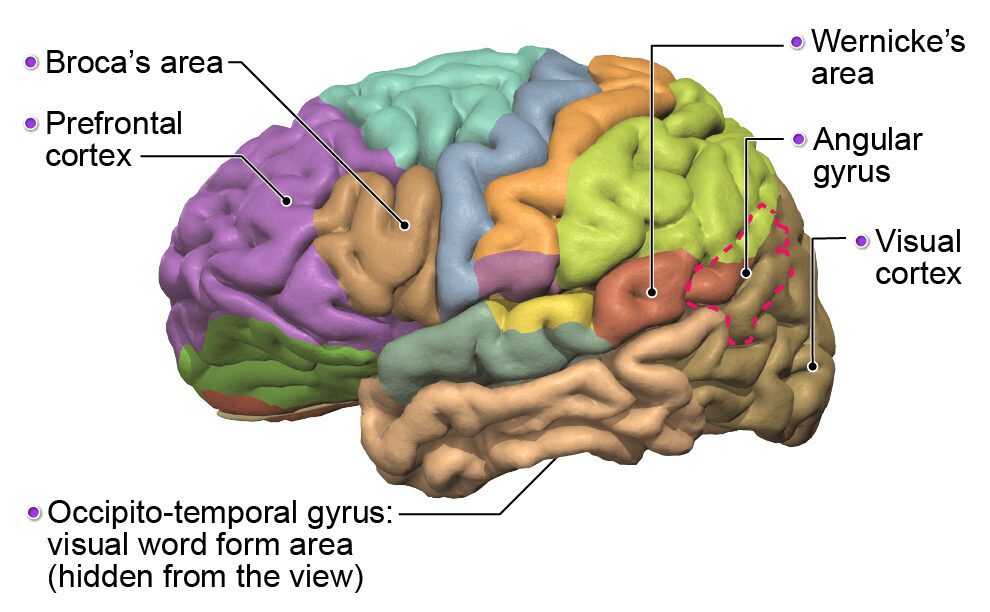
As evidenced by the locations of these areas of the brain, the processes involved in reading — like comprehension and word recognition — don’t occur in a single region, but rather across two distinct brain networks. Communication among these areas is facilitated by the corpus callosum, a region of white matter tracts of the brain connecting both of its hemispheres. While reading is typically dominant in the left hemisphere, the corpus collosum enables the integration and transfer of information from each hemisphere, allowing the brain to process sensory information, motor signals, and advanced cognitive operations.
What is the emotional impact of reading?
So how do all of these signals being transmitted to and from various parts of the brain during reading translate into your emotional experience while reading a book, news article, or even a text from a friend (or enemy)? This is where the body’s limbic system comes into play.
The limbic system consists of various structures of the brain that work together to regulate emotions, behavior, and motivation (including things like survival instincts). These include the amygdala, which is located in the lateral lobe, next to the thalamus and behind the hippocampus. It is where the brain produces feelings of fear in response to threats. Another key area of the limbic system is the hippocampus, where experiences are encoded into the brain as long-term memories.

The limbic system also interacts with the mirror neuron system, which plays an essential role in facilitating the process of producing empathy by enabling social mirroring. This mirror mechanism is what allows us to observe the actions of others, and understand why they are acting that way and to comprehend their emotions, thereby giving us a deeper connection with both our fellow humans and a deeper understanding of ourselves.
When we read, especially when we read fiction, we use a combination of our imagination and these mirror neurons to envision the events depicted on the pages, allowing us to mentally enter the world that the book is describing. Those who study narrative psychology refer to this as narrative transportation, a state in which the reader becomes wholly immersed in a story, directing all of their thoughts, feelings, and attention to the events unfolding on the page. In this state of “transportation,” readers begin to experience real emotions tied to the fictional circumstances described in a book. Thus, your body reacts with a rapid heartbeat when a protagonist narrowly escapes a killer or produces tears and feelings of sadness when star-crossed lovers are kept apart by extenuating circumstances.
What are the psychological and physical benefits and pitfalls of reading?
Anyone who has ever been caught up emotionally in a good book will tell you that reading has the ability to transport them to another place — even another dimension or planet — enabling readers to put themselves into other settings and in the shoes of characters both similar to and different from them in many ways. The ability of fiction to make readers more socially adaptable, and to move readers to react to fictitious circumstances in a genuine emotional manner, is also thought to enable readers to become more empathetic while attaining a greater understanding of themselves in the process.
However, there can also be too much of a good thing when it comes to reading. Voracious readers may suffer from the potential downsides of the activity. This can include physical reactions like eye strain, which may be exacerbated by circumstances like improper lighting, excessive exposure to screens, and not wearing the proper corrective eyewear, if needed. Long hours spent sitting and reading can also have unintended physical consequences, with sedentary behavior associated with an increased risk of cardiovascular disease, type-2 diabetes, and obesity. In addition to physical manifestations of “overreading,” readers can become overwhelmed and overloaded by the sheer vastness of information available to them while reading — especially reading online articles containing lots of hypertext, or links out to additional information (like the one you’re reading now). Following information down various rabbit holes also increases the risk of losing track of time while reading — time that may have been important for completing other vital tasks.
Fortunately, there are some simple guidelines to maintaining healthy reading habits. These include steps to take to ensure you are getting the most out of reading and maximizing your ability to remember and understand what you have read, while leaving time for other things in your life. Actions like taking notes of important details, talking over what you’ve read with others to build social connections (as in book clubs or discussion groups), and taking breaks to reflect on the content you are reading can all help you not only comprehend materials better, but maintain your physical and mental wellbeing.
The content in this post is from Primal’s 3D Atlas and Head & Neck Basic Neuroanatomy modules on Anatomy.tv. To learn more about this or other Primal learning resources, please fill in the form here and our team will be in touch.